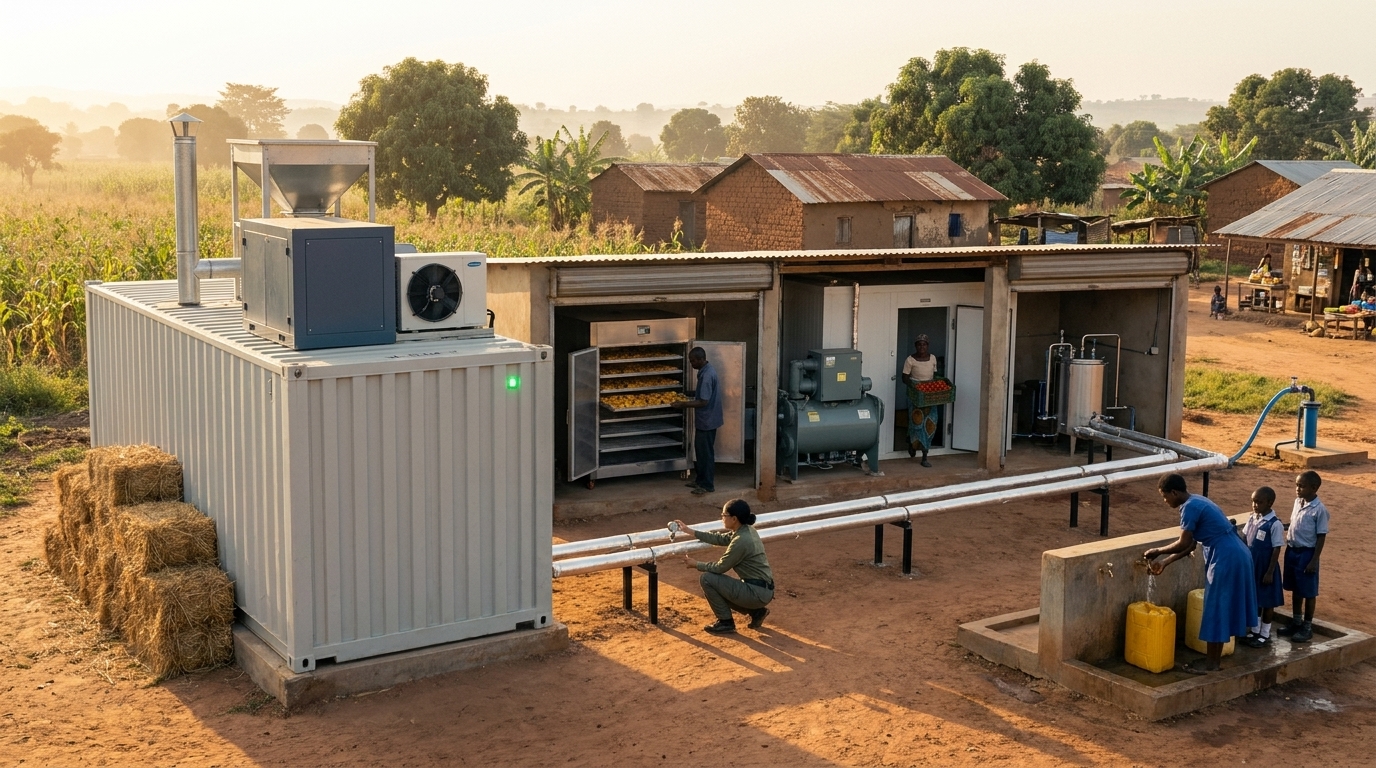
For a dairy, a market or a clinic, heat could mean food kept cold, harvests dried and water made safer to drink. Jenja is designed to produce heat as well as gas, and that heat could be put to work.
Both usually need energy, and where energy is scarce the trade-off gets made at household level: boil it, or drink what is closest.
people, one in four worldwide, were without safely managed drinking water in 2024.32
deaths among children under five in 2019 linked to unsafe water, sanitation and hygiene. Part of 1.4 million such deaths in total that year, most of them from diarrhoeal disease.33
For a clinic, a market or a dairy, the absence of cooling or safe water is not an abstraction. It decides what can be stored, what can be sold, and what can be treated safely.
Jenja is designed to produce useful heat. In the right system, that heat could support cooling, drying and water treatment.
The route itself has been studied. Researchers have modelled a biomass gasifier, an engine and an absorption chiller working together to supply a building with power, heat and cooling.34
Residue that is currently a disposal cost, a nuisance or an open pile.
Jenja is designed to convert it into fuel gas and heat.
In its power configuration, Jenja is designed to produce its own electricity. Its electrical output has not yet been measured.
Heat applied to water for long enough to make it safe, using heat from Jenja rather than extra fuel.
An absorption chiller driven by the same heat stream, where the site has a cold load that justifies it.
Who benefits, and by how much, depends on ownership, operation, tariffs and local conditions.
Each step becomes real once Jenja runs at a site.
How heat makes water safe. Most pathogens are inactivated at 60 to 70 degrees Celsius for at least one minute, and practical guidance is 70 degrees for 15 minutes.35 Pasteurisation gives no lasting protection, so treated water should be used soon and stored in safe containers.36 Pasteurisation does not remove turbidity.37
The next step is a site with a real need for cooling or safe water, such as a dairy, a market, a clinic or a port, where Jenja's heat can be measured and put to work.